
Fairfax City Directory Collections
Fairfax County does not have one confirmed, uninterrupted published city-directory run. The documented starting point is the Virginia Room at the City of Fairfax Regional Library, where local history material is held alongside telephone books, newspapers, maps, manuscripts, and microforms. Its catalog provides evidence of several late twentieth-century community phonebooks, while the library guides point researchers toward broader city-directory and telephone-book holdings. Ask for the exact publisher, year, and whether a volume includes a street or reverse section before treating it as an address source.
| Fairfax collection | Documented years or scope | Keeper | How to use it |
|---|---|---|---|
| Community phonebooks | 1993, 1996, and 1997 visible; seven catalog records | Virginia Room catalog and physical holdings | Ask staff for publisher, missing years, and reverse pages |
| City directories and telephone books | Complete official run not exposed in the inspected catalog | Virginia Room guide and collection | In-person or email reference request |
| Fairfax Herald index | 1886-1936 | FCPL and Virginia Room research materials | Use name, birth, marriage, obituary, and place leads |
| Fairfax County Independent | April 11, 1929 to December 22, 1932 | FCPL local newspaper materials | Confirm the reel, issue, and page |
| FCPS yearbooks | More than 300 digitized volumes from 36 schools | FCPL, Internet Archive, and Virginia Room | Search by school and approximate year |
| Historic circuit and county books | Series-specific historic material | Historic Records Center and Library of Virginia | Use a reader, appointment, or archive request |
That distinction matters. A community phonebook may show a name and number but not resident status, and a business listing can show an office address instead of a home address. No complete Fairfax reverse-directory run or final printed year was confirmed in the research, so staff confirmation is part of a careful city-directory search.
Fairfax City Directory Desk
The Virginia Room is the local access point for a Fairfax city directory question. It is on the second floor of the City of Fairfax Regional Library, 10360 North Street, and keeps local-history and genealogy books, maps, photographs, manuscripts, newspapers, rare books, and microforms. Eight public internet stations, a microform reader-printer that can save to USB, and a designated CPAN station give researchers several ways to move from a printed name to a cited record. The room can be reached at 703-293-6227, option 6, or va_room@fairfaxcounty.gov.
Start with the library's City Directories and Telephone Books guide, then give staff a surname, date range, street variant, and the kind of entry sought. The genealogy guide and local catalog are useful parallel routes when a directory title is uncertain. In-person browsing, email reference help, microform, and the CPAN station are distinct channels, so a missing online listing does not mean the physical shelf is empty.
See the Virginia Room source page before a visit.
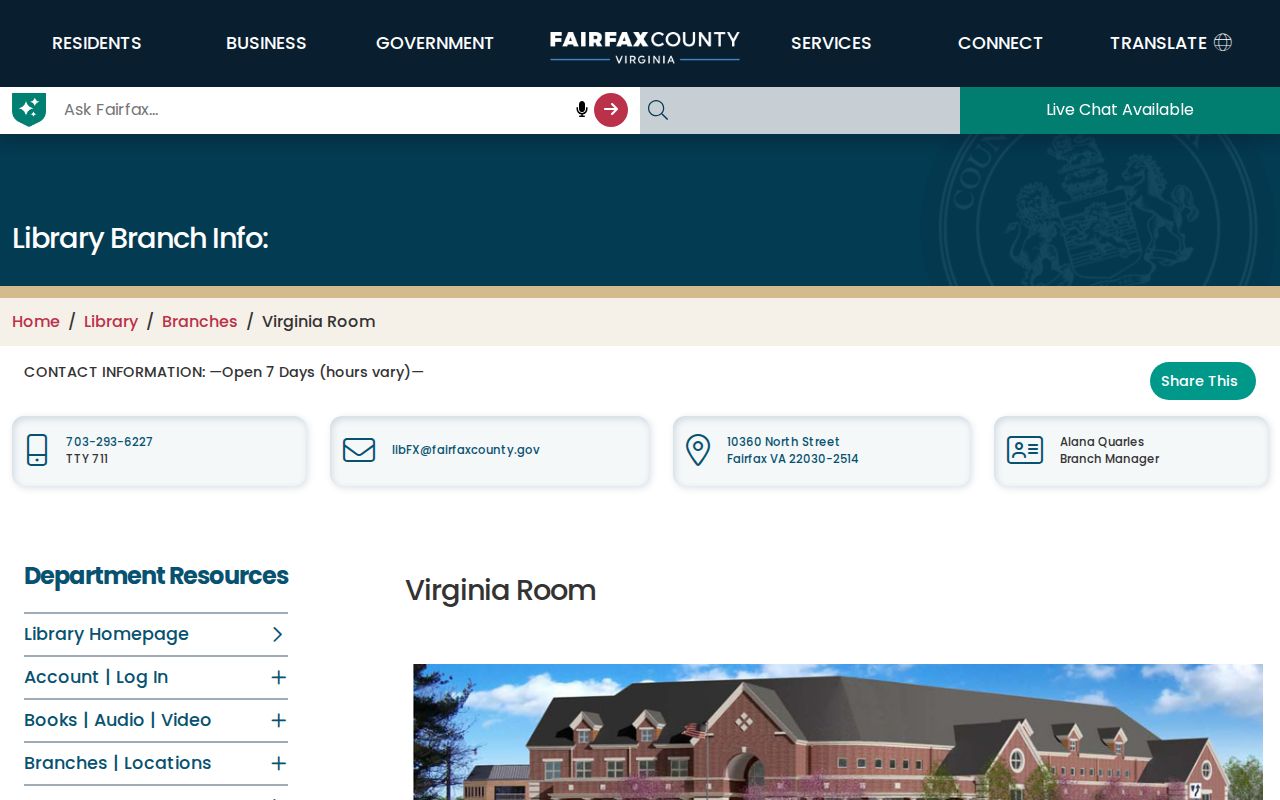
The room's mix of local collections and public research equipment makes it the practical first stop when a Fairfax city directory title is known only in part.
Fairfax City Directory Catalog Facts
The public Polaris search for “COMMUNITY PHONEBOOK” produced seven records associated with Fairfax, Clifton, Fair Oaks, and Fairfax County. Six visible records named Data National as publisher, and one named YPG Directories LLC. The visible publication years were 1993, 1996, and 1997. Those details support a request for late-century telephone-book material, but they do not establish the first, last, or every intermediate year of a Fairfax city directory collection.
Use the catalog result as a request slip, not a complete bibliography. Ask whether a matching volume has name pages, a street-order portion, a publisher key, or a separate reverse book. If staff locate a volume, retain its catalog identifier, volume year, and page image with the transcription. That record trail lets another researcher distinguish a directory entry from an undated family recollection.
The catalog search result shows the documented community-phonebook records.
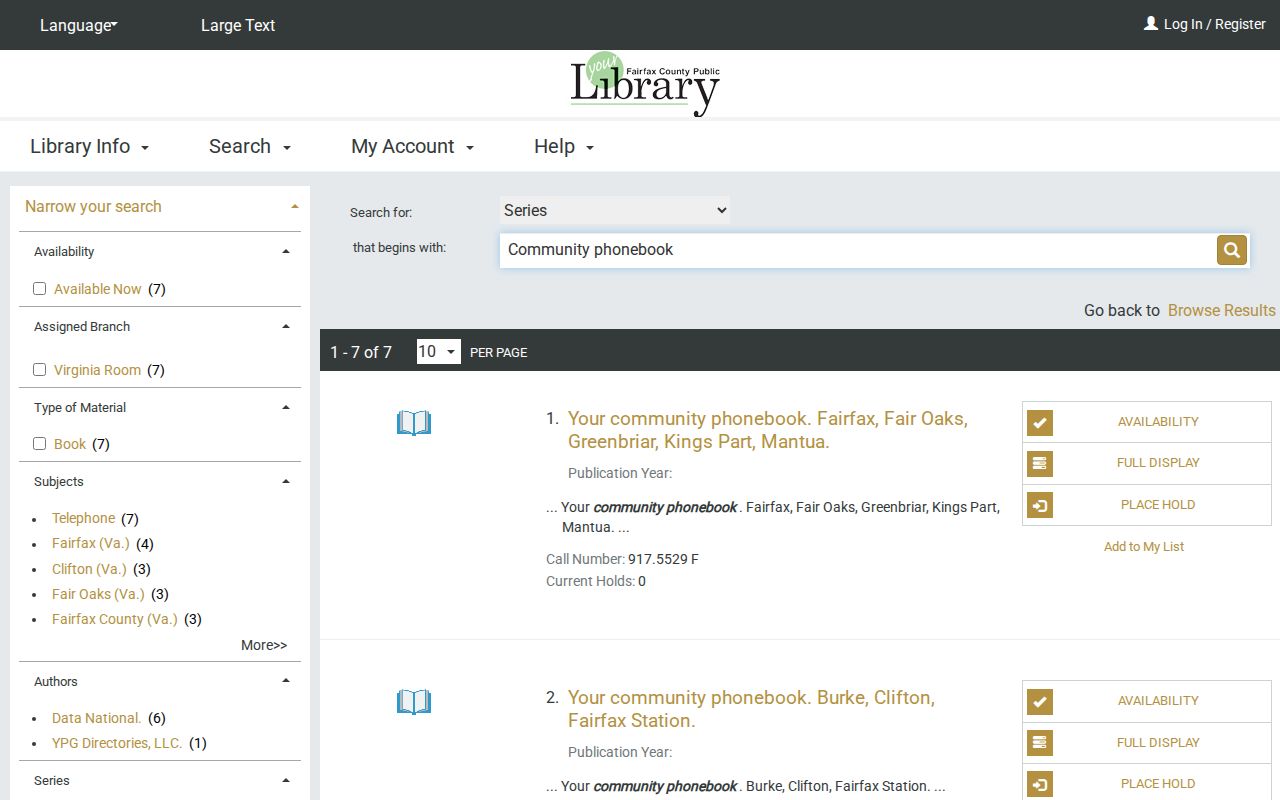
The visible publishers and years are a useful starting inventory, while the unconfirmed gaps are a reason to ask the Virginia Room for a shelf-level check.
Note: Catalog metadata identifies holdings, but it does not prove that every listed volume includes the same kinds of name or street pages.
Reading Fairfax City Directory Entries
Read a Fairfax city directory entry exactly as printed. Depending on the volume, it may give a surname and given name, a spouse or household notation, an occupation, an organization, a street address, a telephone number, an ownership or occupancy mark, or a widow notation. Each volume uses its own abbreviations. A code that looks familiar can mean something different in another publisher's book, so photograph or copy the abbreviation key before expanding a shorthand term.
| Entry heading | Record the name and any spouse or household notation exactly as printed. |
|---|---|
| Address line | Keep the street number, unit, directional marker, and any “rear” notation. |
| Work field | Transcribe the occupation or organization only when visible, with the volume's key. |
| Household marks | Note a telephone, ownership or occupancy mark, or widow notation only if the entry shows one. |
| Source citation | Keep the page, volume year, publisher, and catalog, reel, or image identifier. |
- Criss-cross directory
- A directory section arranged by street or address rather than by surname. Fairfax's complete run needs staff confirmation.
- Householder index
- A name-oriented listing for the person or household used to organize an entry.
- Abbreviation key
- The publisher's explanation of short forms, usually within the same volume and essential to a reliable transcription.
Check a name entry against the street or reverse section if one exists. A direct name listing can be incomplete, and an address in an old book may use a prior road name, an apartment notation, or a postal place that does not match a modern map.
Fairfax City Directory Press Index
The Historical Newspapers guide adds a local date layer to a Fairfax city directory trail. The Fairfax Herald index covers 1886 through 1936 and separately indexes births, marriages, obituaries, and place names. The Fairfax County Independent has a shorter documented run, from April 11, 1929 through December 22, 1932. Both are name leads rather than proof that every issue or obituary is online.
Search surname variants, initials, a spouse, subdivision, road name, school, or organization. Then verify the reel, issue, page, and publication date in the Virginia Room. An obituary can point toward probate, a cemetery inquiry, marriage material, or a deed, but it should not be treated as a final legal-address record on its own.
Note: A newspaper index can narrow a Fairfax city directory search to a date range, but the underlying issue remains the source to cite.
Fairfax City Directory Yearbooks
When a person disappears from a Fairfax city directory, school material can supply a different kind of historical connection. The FCPL yearbook project reports more than 300 digitized FCPS volumes from 36 schools, nearly 500 physical yearbooks, and more than 13,400 images in the Virginia Room photo archive. Identify a school and approximate graduation year, inspect the class pages, and then compare the name with a directory, newspaper, or official record from the same period.
Yearbooks are social snapshots. They can place someone in a school community, show a spelling variant, or suggest an organization for a newspaper search. They do not establish a current address. The Virginia Room's photographs, maps, and manuscripts can add place context, while the directory volume provides the dated address lead.
Tracing Fairfax City Directories
A useful Fairfax city-directory timeline moves one documented year at a time. First locate the earliest confirmed entry, then record each later entry with its page and address exactly as printed. A name that changes form, vanishes, or appears at a new street is a lead to test, not a conclusion. Census schedules can provide household context through 1950, the latest public individual federal census, while later newspaper and record trails require their own dates and custodians.
- Find the first verified directory or phonebook entry and record the year, page, publisher, and spelling.
- Follow the surname through later accessible volumes, noting each street, telephone, spouse notation, and abbreviation key.
- Check the same volume's street or reverse section when it exists, and record whether that section is missing or unconfirmed.
- Pair the dated entry with the nearest available census, newspaper index, deed, tax, probate, or vital-record lead.
- Label the jurisdiction before joining records because Fairfax County, the City of Fairfax, Vienna, and Herndon are not interchangeable custodians.
A person can leave a directory because of a move, death, a name change, an omitted listing, or a changed publication practice. A second source is needed to decide which explanation fits. For a current address-keyed record route after the historical work, use the Fairfax street directory rather than assuming the old volume has modern coverage.
Fairfax City Directory Record Gaps
Some Fairfax research gaps are historical, not a failed search. Fairfax County was formed in 1742, and surviving land and court books reach into the colonial period. Yet the 1875 courthouse fire and Civil War-era losses left incomplete chancery material and missing court-order years. The Historic Records Center's current researcher material identifies missing deed-book series and pages. A break in a household trail may reflect a lost record, a different custodian, or an old address format rather than an absent event.
The Fairfax County History Commission provides local-history contact and program context through the Virginia Room. Its awards material recognizes Edith Moore Sprouse's index, abstract, and microfiche work, which is a useful clue that older research may sit in an index or reader rather than a modern name search. Use tax books, neighboring deeds, plats, newspapers, court orders, census, and probate material to rebuild a broken period.
View the History Commission source page for the local-history contact context.
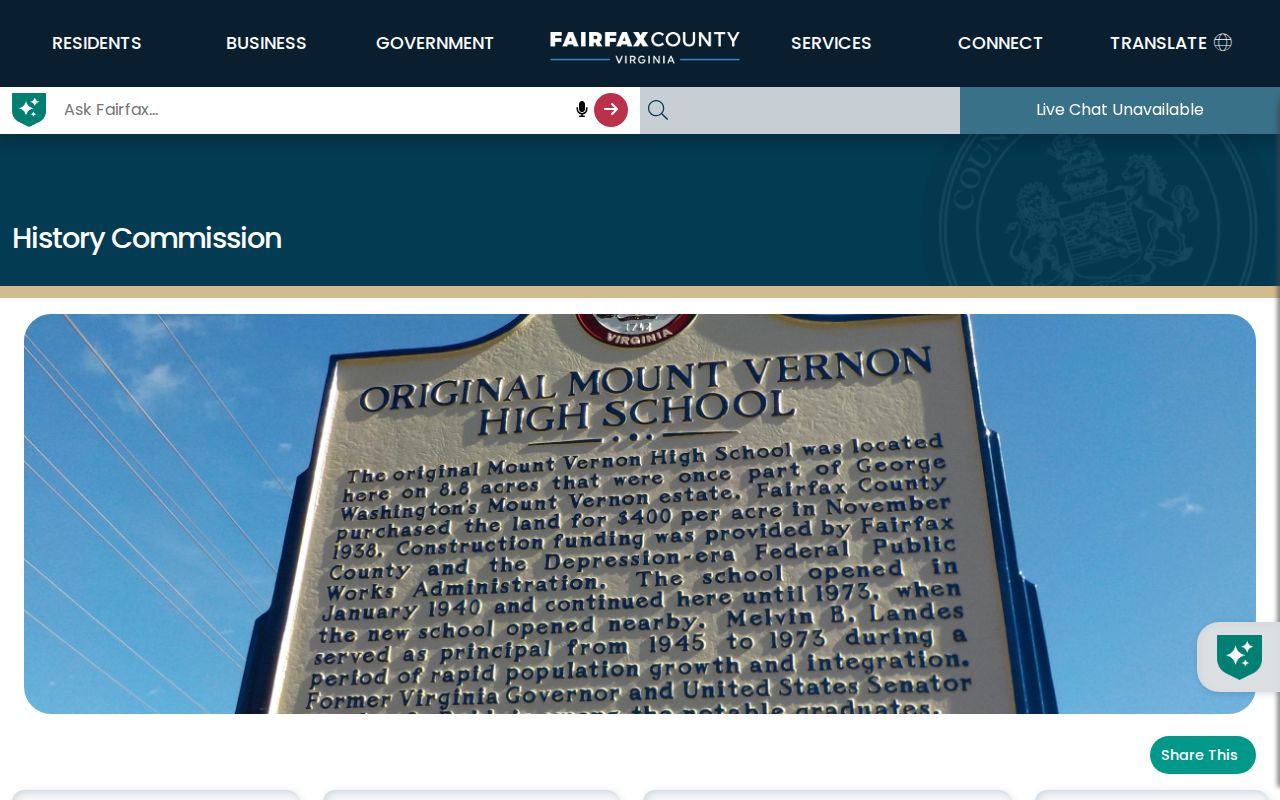
The commission is a context and referral route, while the Virginia Room, Historic Records Center, and record custodian remain the places to request a specific item.
Fairfax City Directory Archive Requests
When a catalog search stops short, make a narrow request. The Virginia Room can help identify collection titles and microform, and the Fairfax Historic Records Center holds historic deed books, taxes, court orders, wills, chancery material, and registrations. The Library of Virginia Fairfax collections are the state archive route for Fairfax microfilm and county record books. Give each repository a name variant, year range, place, and record type.
For county government material that is not available through an index, the Fairfax County FOIA route is for existing records held by the responsible agency. It does not require an agency to create a resident list or conduct an open-ended family search. Ask for a defined record set, such as a named meeting file or a date-bounded historic item, and keep the repository's response with the research notes.
Note: The best Fairfax city directory request names a person, time span, place wording, and collection type instead of asking an archive to infer a whole household history.