
Fairfax Sources for Previous Residents
Fairfax address history has an owner trail and a household trail. Land records provide the owner side, while older directories, newspapers, and census schedules can add people who were connected to an address in a specific period. Start with the modern parcel because its PIN and legal description make the bridge to deed records. Then choose the record series by date. Early deeds and tax books are strongest at the Historic Records Center, not in a simple address search.
| Source | Years It Covers | Where Held | What It Shows |
|---|---|---|---|
| Deed and land records | 1742-present | CPAN, courthouse terminals, HRC, LVA microfilm | Owners, sellers, legal descriptions, plats |
| HRC deed books/indexes | 1742-1942 books; 1866-1946 indexes | Historic Records Center | Earlier owner chain and gap checking |
| Community phonebooks | 1993, 1996, 1997 visible | Virginia Room | Name, telephone, and address leads |
| Federal census | 1790-1950 public | NARA and library/archive routes | Household composition and later street context |
| Permits and imagery | Current/migrated; imagery from 1937 | PLUS and Fairfax GIS | Structure or project chronology |
For a recent transfer, begin in iCare and then identify the deed. For a nineteenth- or early twentieth-century question, start with the HRC coverage and its recorded gaps. For a former household, use a dated directory or census entry as one layer in the address timeline rather than a substitute for the deed chain.
Fairfax Parcel First
Before tracing past residents, open the present address in Fairfax iCare. Record the map number or PIN, property or situs address, owner, tax mailing address, sale history, subdivision, and legal-description fields. The owner and mailing address may point to an estate, trust, representative, business, or outside address. Treat them as recorded assessment facts, not as a complete account of the people who lived there.
Next, open the iCare map or a Fairfax GIS layer to confirm parcel shape, adjoining roads, and jurisdiction. Historical imagery reaches back to 1937 and can help date a visible structure or road layout. It cannot name a former household. That distinction keeps a physical-history clue from being mistaken for a person record.
Fairfax Deed Books and Gaps
Land records reach from 1742 to the present, but their strongest access route changes with the era. The Historic Records Center guide identifies deed books from 1742 through 1942 and grantor/grantee indexes from 1866 through 1946. Some surviving series have missing volumes or pages. A break in a chain is therefore sometimes an archival gap, not proof that an owner change did not occur. Check the HRC holdings, tax books, neighboring deeds, plats, probate, and newspaper notices before closing the trail.
The 1875 courthouse fire and Civil War-era losses also affect old Fairfax court materials. Tax books, later confirmatory deeds, and related parcels can help reconstruct context when a direct volume is missing. Preserve the exact book, page, and omission in the research note.
Note: A gap found in the Historic Records Center’s published series is evidence about record survival, not about a former resident.
Fairfax Address Change Clock
Modern numbers and old documents may not line up. The Master Address Repository retains effective, status, change, and expiration dates. An approved Fairfax address change can reach GIS, MAR, iCare, and PLUS on the next business day, while other systems can take up to a week. Old deeds may instead use a rural route, farm name, road alias, or lot and block description.
Normalize the address before looking for previous residents: retain the original spelling, note the current parcel PIN, capture any older road name or subdivision section, and check the legal jurisdiction. Fairfax, Falls Church, and Alexandria postal labels do not automatically identify the responsible land-record office.
Tracing Fairfax Owners Backward
The deed index is organized by grantor and grantee, not by a modern street number. Use the iCare PIN and legal description to locate the current conveyance in the Fairfax Circuit Court land-record path. The buyer in that deed is the grantee. The seller is the grantor. Search the seller as a grantee to find the earlier acquisition, compare the legal description, and repeat. Check spelling variants, spouses, trusts, estates, and corporations at every transfer.
- Capture the current parcel PIN, owner, and legal-description data in iCare.
- Find the owner’s purchase as a grantee in CPAN, a courthouse terminal, or the Land Records research room.
- Read the deed for the seller, instrument details, legal description, and any prior-deed reference.
- Search that seller as a grantee and compare the parcel description before moving one transfer farther back.
- Move to HRC deed books, index volumes, or LVA microfilm when the needed period is not available in the current online layer.
- Grantor / grantee
- The grantor transfers an interest; the grantee receives it in the recorded instrument.
- Chain of title
- The ordered record of transfers for one parcel, tested by matching legal descriptions rather than names alone.
- Legal description
- The lot, subdivision, plat, or metes-and-bounds language that identifies land even when a street number changes.
Fairfax “And Being” References
Fairfax’s land-record indexing guidance explains an important chain-of-title trap. An “And Being” clause in a deed commonly names a prior deed book and page, but only the current number may be indexed. Easements can place names in an unexpected order, an asterisk can mark an additional name, and a deceased owner or trust may not be indexed in the way a researcher expects. Read the signature page and the instrument text before deciding that a surname has vanished from the chain.
CPAN is the paid subscriber portal that carries land records and several related record families. New users submit entity and user agreements and the cited cost is $150 per user by check or money order, with quarterly invoices. The courthouse terminals, Historic Records Center, and Virginia Room CPAN station are the practical alternatives when a browser search is not enough.
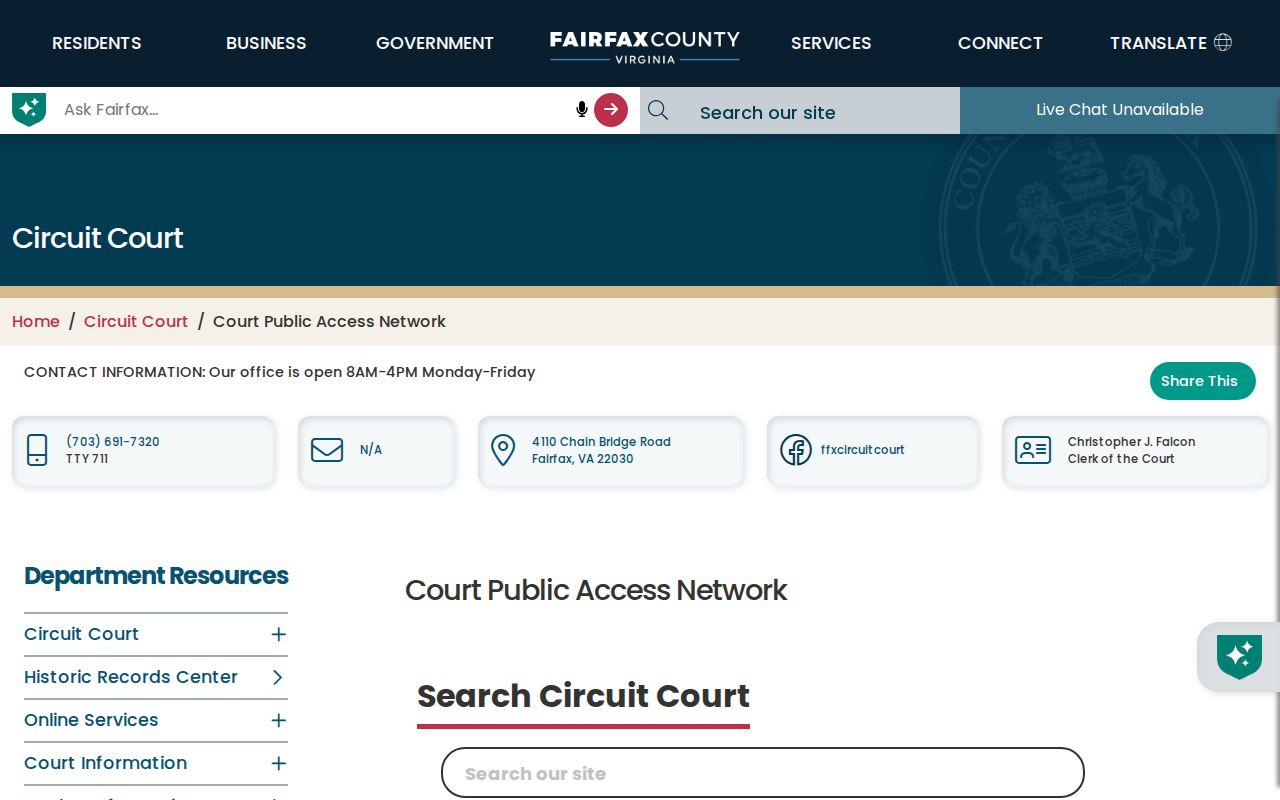
The subscriber path extends the deed search, but a direct image, book, or clerk copy request remains necessary for a document-level conclusion.
Fairfax Microfilm and Archive Route
The Library of Virginia catalog provides a separate route for Fairfax County microfilm and county record books. Use it when the chain has reached an older deed, tax, probate, or court series. The HRC also holds original wills from 1742 to 1935, land tax books from 1851 to 1980, personal-property tax books from 1851 to 1939, and other series that can place a parcel or family in time. Access is series-specific, so contact the repository with the exact address, years, names, and book details already found.
The Library of Virginia Fairfax County microfilm catalog entry is a useful archival handoff when a county web result reaches its historical boundary.
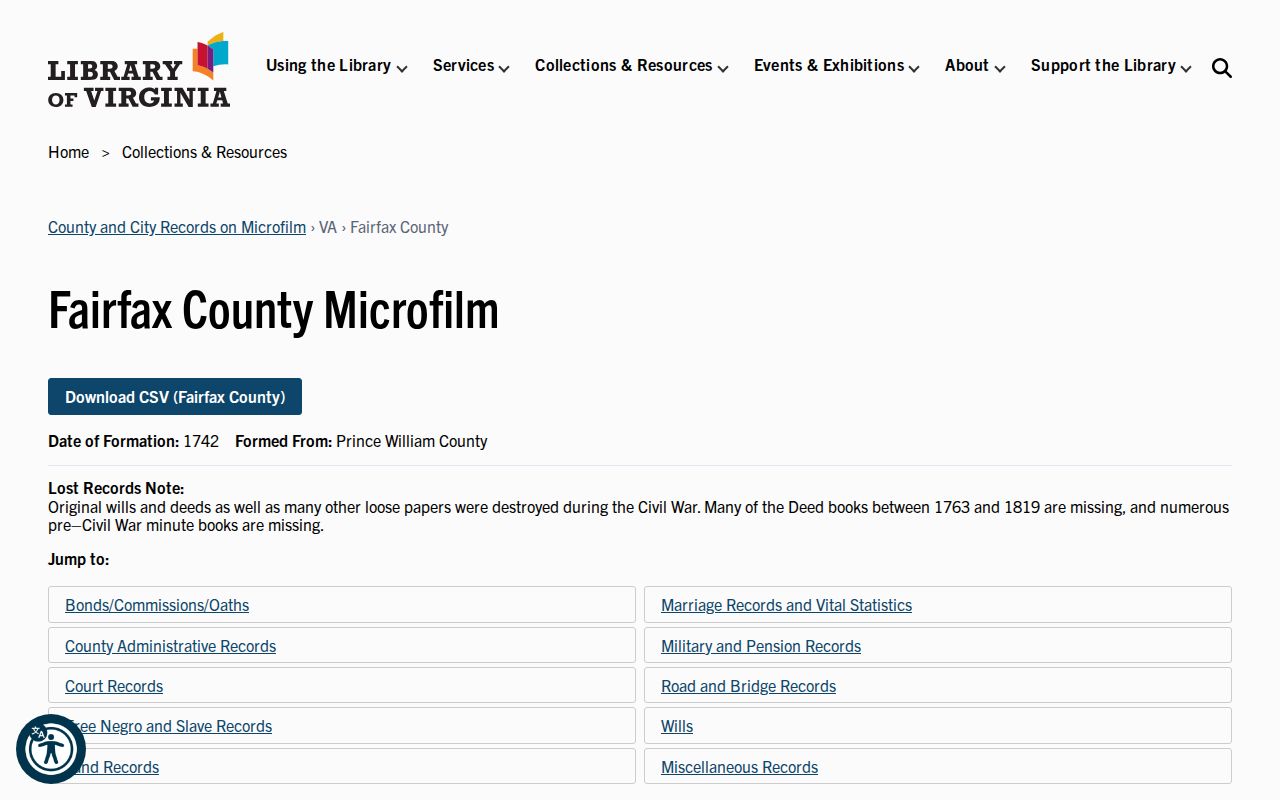
Archive cataloging identifies a series and format; inspect the reel, book, or cited image before assigning a person to the address.
Fairfax Structure Dates and Permits
A home’s physical history can organize the search for previous residents without identifying them by itself. Fairfax GIS historical imagery reaches back to 1937 and supports comparison of a parcel, road alignment, and structure footprint. The county’s PLUS system searches current and migrated permit or development records by site address, parcel number, record number, record type, project name, dates, unit, city, state, and ZIP. It can place a construction, alteration, or code event on the address timeline.
PLUS requires an account to submit or track an application, while its public search is a reference route. Older records may sit with Land Development Information History rather than the migrated screen. A permit applicant, contractor, or code record does not prove that person lived at the address. Use it to test the building chronology against deeds, directories, and historical imagery.
Fairfax Past Household Evidence
Previous residents are not always the names in a deed chain. The Virginia Room’s community phonebook records, local newspaper indexes, yearbooks, and public census schedules can show a different household layer for a particular year. The phonebook catalog visibly includes Fairfax-related records for 1993, 1996, and 1997, but the full run and reverse sections must be confirmed with staff. The detailed collection guidance is on the Fairfax city directory page, rather than repeated here.
Pair each source with its own date. A directory entry may show a name, spouse notation, address, telephone, or an abbreviation specific to that volume. Federal schedules through 1950 can show household composition and, in later eras, street information. The Fairfax Herald Index, 1886 to 1936, can lead to a birth, marriage, obituary, or place item. An obituary or probate file can close an address trail, but it should be checked against the publication date, court file, deed, or cemetery custodian.
- Place the deed transfer and its legal description on an address timeline.
- Request the nearest available Virginia Room directory or phonebook volume and retain its page and year.
- Compare a household entry with the nearest public census schedule, preserving the jurisdiction used at that date.
- Use newspaper, probate, vital-index, and cemetery leads to test later or earlier transitions.
Lawful use. Fairfax previous-resident research is for family history, property history, estate work, and personal curiosity. Never use address or archival material to stalk, harass, threaten, or harm a living person.