
Fairfax Neighbors by Block
Public sources around a Fairfax address answer different questions. The parcel record can identify a recorded owner, while the map supplies the physical relationship between parcels. The Master Address Repository, known as MAR, helps distinguish an address from a unit or an old address form. A voter-list product can supply limited public registration evidence only under Virginia law and the product's rules. Association contacts and archives can offer community context. None of these alone proves every person who lives near the target.
| Fairfax block source | What it shows | Access |
|---|---|---|
| DTA iCare | Parcel owner, situs and mailing address, sales, values, and physical characteristics | Free address or map search; expanded owner search is in paid CPAN |
| Jade and iCare map | Parcel shapes, adjacent parcels, districts, imagery, and selected parcel links | Free map, buffer, measure, and export tools; reference display |
| Master Address Repository | Site addresses, units, parcel PIN, ZIP, jurisdiction, subdivision, and status dates | Free Fairfax GIS service and address authority |
| Voter street file or list product | Street-range precinct geography or lawful public registration fields | 2015 street file; current list request or protected individual portal |
| Association and archive sources | Community contacts, meeting context, local programs, and historical material | County list, organization contact, Virginia Room, or finding aid |
Start with the parcel and separate the two questions that are often confused: who owns land nearby, and who may live nearby. An owner can have a different mailing address, hold title through an estate or entity, or be absent from the parcel. A registered voter is not a census of all occupants. Each source is useful precisely because it leaves a dated, limited trail.
Set a Fairfax Target Parcel
Use Fairfax County Department of Tax Administration iCare to find the exact address before trying to identify Fairfax neighbors. Address mode accepts number, unit, street, suffix, sort, and direction controls. A broad street match can be useful when the suffix is omitted, while a distinctive street fragment can be searched with the documented wildcard approach. Record every returned map number or parcel PIN, then confirm the situs address on the parcel detail. The PIN is a stable bridge to the map, land record, and address authority.
Save the target parcel's owner name, property address, tax mailing address, sale history, and legal-description or subdivision information as separate fields. The map number identifies the parcel; it does not identify a household. If the address is in a postal area that overlaps the independent City of Fairfax, Falls Church, or Alexandria, confirm the jurisdiction before treating Fairfax County as the custodian. The county's own research materials warn that similar postal labels can route property records to different circuit courts.
Note: Record the target PIN and legal jurisdiction before expanding the search, because postal place names and parcel jurisdiction do not always match.
Map Fairfax Neighbor Parcels
From the target PIN, open the iCare map or Fairfax GIS Jade viewer and work outward one parcel at a time. The map supports selection, measurement, map browse, and contextual layers such as zoning, districts, and imagery. In iCare, the practical method is to select the parcel, use the record navigator or parcel search, set a measured buffer in feet or meters, choose center points or polygons, and open each parcel link. A block-sized buffer is safer than a broad area search because the map limits the displayed selection to 1,000 parcels.
- Locate the exact target address and confirm its parcel PIN, situs address, and jurisdiction.
- Use a modest buffer or click the immediately adjacent parcel shapes, then log each PIN and address.
- Open each iCare detail page to separate recorded owner and mailing address from the target location.
- Use a plat, deed, or subdivision record only when a lot line, easement, or prior owner needs clarification.
The flow is address to target PIN, target PIN to adjacent parcel, adjacent parcel to iCare detail, then detail to a land-record or map source when needed. For a full named-street chain rather than the immediate block, use the Fairfax street directory.
Read Fairfax Address Details
MAR is Fairfax County's authoritative site-address layer, while the Department of Tax Administration is the authority for parcel data. MAR includes street and unit parts, city, state, ZIP, parcel PIN, jurisdiction, subdivision, and address effective, status, change, and expiration dates. That distinction matters around apartments, condominiums, new construction, renamed roads, and older records. A map may show one parcel while MAR records several unit-level features. A current address can also have a different historical form in a deed or directory.
Jade's historical-imagery viewer reaches back to 1937 and can be used for place context, not person identification. The address layer and map can also help explain why two Fairfax records use different street forms without declaring either one false. For an address change or a county-assigned street name, contact the Bonds and Addressing Center. Town of Vienna and Herndon applications can follow their own routing. A postal city label is not, by itself, a legal jurisdiction finding.
Fairfax Voter Street Evidence
A Fairfax block can be placed in a precinct context without claiming that a map reveals everyone on it. The 2015 Fairfax Elections street file maps street names, low and high address ranges, odd or even sides, ZIP, precinct, town precinct, and legislative districts. It contains no resident names and is a dated geography tool, not a current registration directory. The Virginia Department of Elections Citizen Portal is the official identity-based route for a person checking their own voter information, polling place, districts, and related functions.
Virginia Code §24.2-444 allows public inspection and list products with restrictions. Authorized products can contain name, residence or mailing address, year of birth, gender, registration status, precinct, and district information, but protected addresses, Social Security numbers, ordinary public full birth dates, and ballot choices are not part of the ordinary public record. The separate voter-list request form uses requester, client-type, geography, and product fields. Ask Fairfax Elections for current guidance by office, phone, or email instead of assuming an unauthenticated portal search exists. The Virginia Department of Elections Citizen Portal remains the official individual route.
Note: A public voter product can be lawful registration evidence, not a complete household list and not proof of current occupancy.
Fairfax Neighbor Association Contacts
County-published neighborhood resources are the useful community layer for Fairfax neighbors. The association list and Community Association Guide identify civic and association resources, including the Fairfax County Federation of Citizens Associations, Fair Haven Citizens Association, Fair Lakes Homeowners Association, and Fairfax Club Estates Homeowners Association. The Federation says it has served county associations since 1940, includes member associations across the county, and holds meetings open to residents. These sources can provide public contacts, meeting context, road-name history, and community issues.
| Fairfax community route | Appropriate use |
|---|---|
| County neighborhoods and association list | Find the association or civic contact for a specific area |
| Fairfax County Federation | Ask about public meetings, association contacts, and civic-history context |
| Association directly | Request public meeting records or historical newsletters, if available |
| Virginia Room | Identify archival community material that a catalog may not fully describe online |
The Fairfax County neighborhoods directory links to the county's neighborhood and association resources.
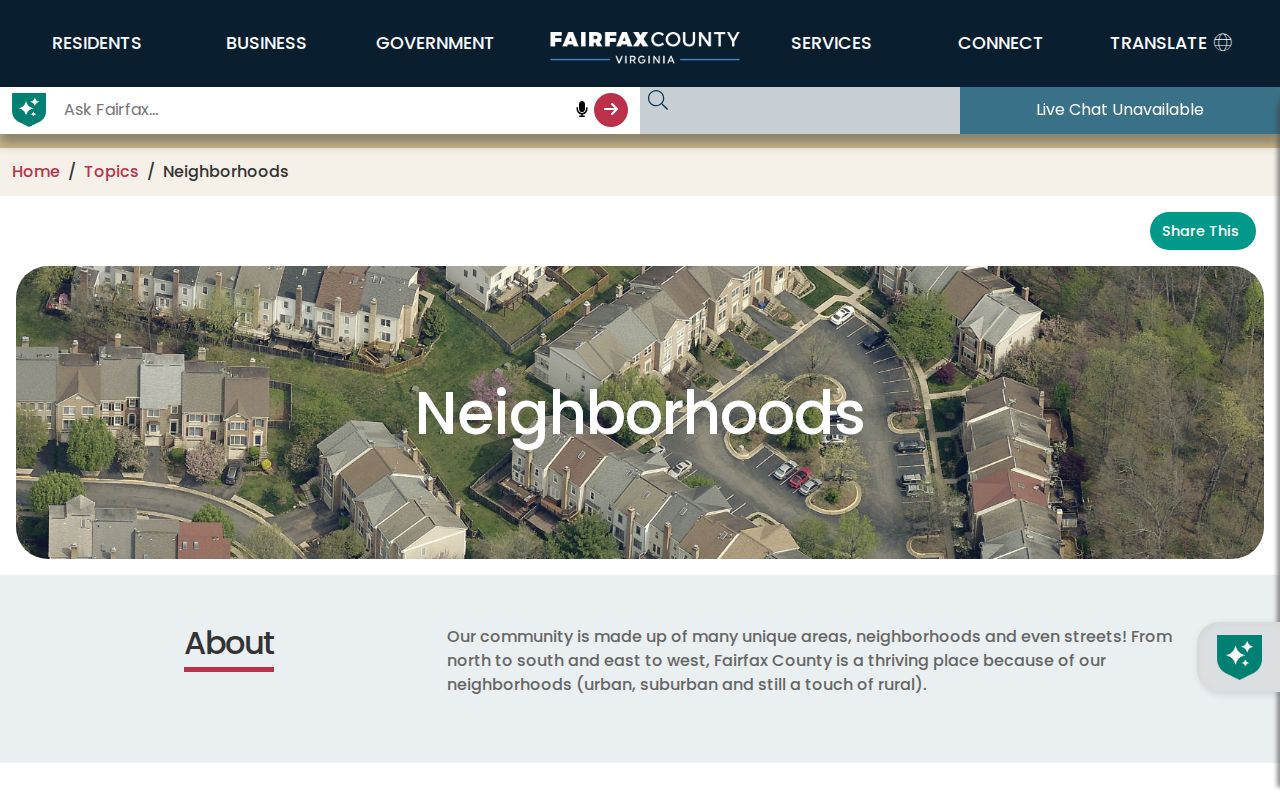
The county directory is a contact and context source. The inspected sources do not establish a public member roster, so an address should never be used to infer association membership.
Fairfax Neighbor Archive Context
For older Fairfax neighbors, the Historical Society of Fairfax County records are a defined archival lead rather than a current people list. The collection, MSS 05-01, spans 1946-2016 and is held at the City of Fairfax Regional Library Virginia Room. Its finding aid describes minutes, correspondence, photographs, yearbooks, reports, membership materials, programs, and other local-history records across 192 components. The catalog did not show online item images. Ask the Virginia Room about access to a specific program, historic-house tour, essay contest, or community project rather than attempting to publish names from membership materials.
The Historical Society of Fairfax County records finding aid identifies the Virginia Room collection and its date span.
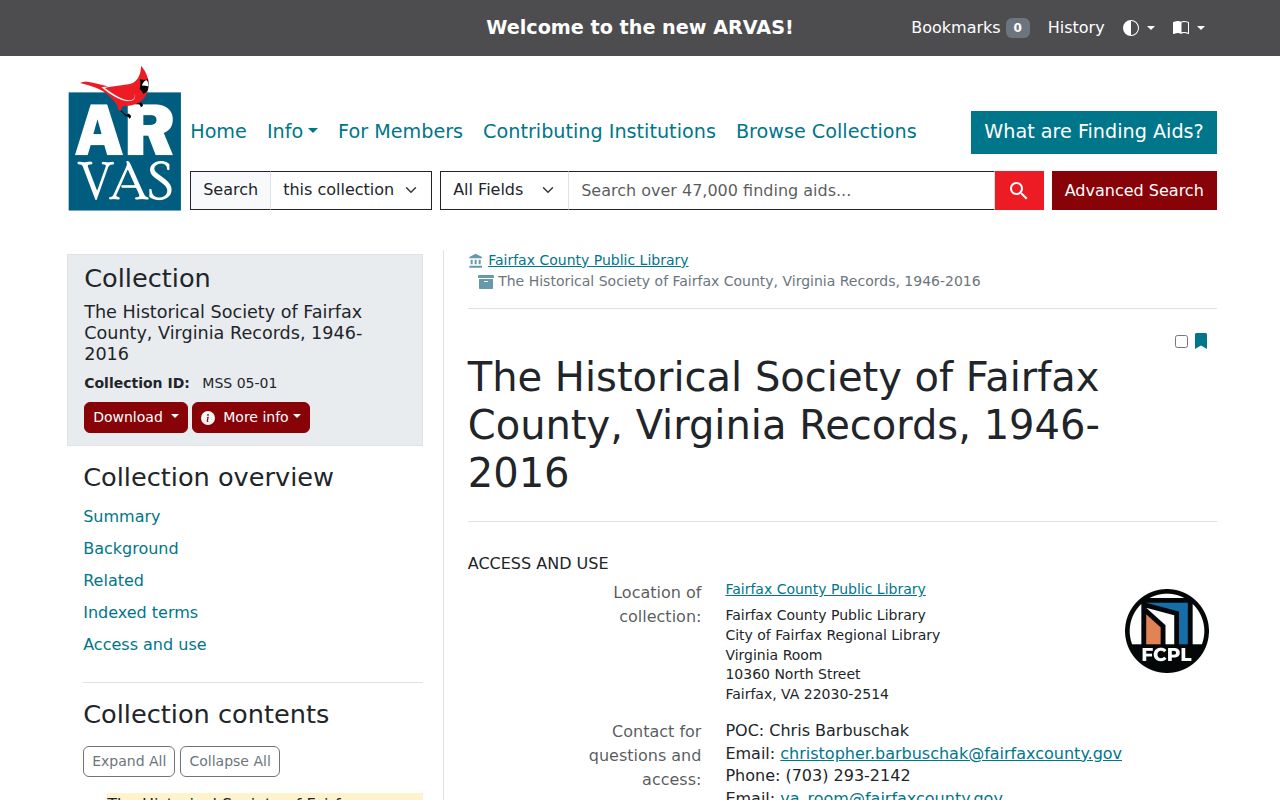
This archive can supply a neighborhood's past context or a route to a custodian, but it should not be treated as a live household directory.
Fairfax Records Around a Block
Address-keyed county records can add place history to a block search. Fairfax County PLUS accepts site address, parcel number, record number, record type, project, date, unit, city, state, and ZIP fields. A permit or code record can show a project date, status, address, or applicant, though older records may not have migrated and an applicant is not necessarily an owner or occupant. For older structures, Land Development Information History, the Virginia Room property-history bibliography, and Fairfax GIS historical imagery are useful fallback channels.
Deeds and plats explain legal parcels. A plat may show lot lines, easements, road dedication, section, phase, block, and lot. A deed can connect a grantor and grantee through a legal description or a prior-deed reference. Fairfax Circuit Court Land Records Division / CPAN, courthouse terminals, and the Historic Records Center provide the main land-record channels. The Historic Records Center and Library of Virginia can help when a historic record is not online. Use those records to understand the parcel, not to assume who occupies every dwelling beside it.
Compare Fairfax Neighbor Sources
Official Fairfax sources state who keeps a record, what date it reflects, and which access limit applies. Compiled commercial neighbor tools may combine old addresses, marketing data, public filings, and purchased datasets without showing a clear source date. That can produce merged same-name profiles, stale addresses, duplicated households, or missing protected people. For a block question, the official parcel and address layers are the place to begin, then a lawful voter, court, archive, or association source can answer a different narrow question.
| Source type | Best use for Fairfax neighbors | Key limitation |
|---|---|---|
| Official parcel and map records | Parcel relationship, owner of record, and address attributes | Does not name every occupant |
| Authorized voter product | Lawful registration evidence and precinct context | Protected addresses and restricted fields remain unavailable |
| Association or archive material | Community contacts and older local context | Not proof of current membership or residence |
| Compiled commercial tools | May provide a lead to verify with a custodian | Can be stale, merged, incomplete, or unclear in origin |
Fairfax Neighbor Lookup Limits
A Fairfax neighbor lookup must stop at the boundary of the record. The county does not publish utility, customer, delivery, or DMV address records as a block roster. Parcel data can identify an owner who lives elsewhere. A protected voter can use a substitute address. The Virginia Address Confidentiality Program provides a designated substitute mailing address for qualifying participants, and special statutory protections can apply to judges, law-enforcement officers, prosecutors, witnesses, and protected survivors. A missing address should not be guessed or filled from an unrelated compiled source.
Contact the actual custodian to correct an error in an official record. A Virginia Freedom of Information Act request can seek existing nonexempt county records, but it cannot require a county office to create an all-neighbors list or disclose protected information. The Virginia Consumer Data Protection Act does not erase a government record that another law requires to be public. Do not reproduce Social Security numbers, full birth dates, signatures, financial-account details, or other sensitive material found in older documents.
Lawful use. Use Fairfax neighbor information for personal, lawful research and community context. Do not use a name, address, or record detail to watch, stalk, harass, threaten, or intimidate anyone.