
Fairfax Resident Lookup Records
One Fairfax resident lookup may require several custodians because no county file is a complete household list. Assessment and land records are strongest for an owner and a parcel. The voter-record system can provide registration evidence only through its protected individual route or a lawful list product. Court indexes identify cases and parties, while vital and archive sources help establish an event or an older connection. Keep the source date with every result. Fairfax County and the independent City of Fairfax are different jurisdictions, even when a mailing address uses Fairfax.
| Fairfax record | What it can confirm | Custodian | Access route |
|---|---|---|---|
| Assessment parcel | Owner, situs or tax mailing address, sale context | Fairfax County Department of Tax Administration iCare | Free address or map search; expanded owner search is in paid CPAN |
| Land record | Buyer, seller, recording date, legal parcel link | Fairfax Circuit Court Land Records Division | CPAN, research terminals, Historic Records Center, or copy request |
| Voter record | Registration evidence, status, precinct and districts | Virginia Department of Elections Citizen Portal | Identity workflow or a statutory list-request product |
| Circuit or district docket | Party name, filing date, status and case events | Fairfax Circuit Court eCaseSearch | Free index, then clerk file review or copy route |
| Vital record | Birth, death, marriage or divorce event | Virginia Department of Health Division of Vital Records | Index, application, or archival research according to eligibility |
Begin with a name and the most dependable extra fact. For a current ownership question, use the parcel path. For a dated legal event, use the court path. For an older family question, combine a vital index with probate, newspaper, or Virginia Room material. A record match becomes stronger when its date, jurisdiction, and address story agree with another source.
Note: A Fairfax postal label can cover county territory or the independent City of Fairfax, so confirm the legal jurisdiction before requesting a record.
Fairfax Names in Property Records
For a name-to-address question, the paid real-estate layer in Fairfax Circuit Court Land Records Division / CPAN can test an owner name. Free iCare works in the other direction: use a known address, map number, or map search to verify a candidate parcel. Its parcel detail can show the owner, situs address, tax mailing address, sale history, physical characteristics, and legal-description context. A mailing address may belong to an estate, trust, representative, business, or owner outside the county, so it is a dated lead rather than a statement that someone occupies the property.
Land records reach from 1742 to the present, while early material and pre-1945 deed books are especially important at the Historic Records Center. CPAN is a subscriber service, and courthouse research terminals offer another access channel. When a record is not practical online, the Land Records office accepts defined copy requests, and the Historic Records Center, Virginia Room, and Library of Virginia provide historical research routes. The deed index is keyed to grantor and grantee, not a modern home address. A parcel PIN and legal description are the bridge between a street address and a deed.
Fairfax Voter Record Routes
The Virginia Department of Elections Citizen Portal is the official place for a person to check their own voter record, polling place, districts, absentee status, and voting history through a log-on and identity process. Its inspected public screen did not expose an anonymous Fairfax name search. Fairfax Elections also offers help by phone, email, and office visit, and paper registration applications are available at libraries, Board of Supervisors offices, and the elections office. Those channels help a voter use their own record; they are not a general resident search.
A lawful public voter-list product has a different route. Virginia Code §24.2-444 covers public inspection and list products, subject to request terms and protected-address rules. Depending on the authorized product, fields can include name, residence or mailing address, year of birth, gender, registration status, precinct, districts, registration date, and participation history. It omits Social Security numbers, ordinary public full birth dates, ballot choices, and protected address details. The request form uses client categories, geographic filters, a product selection, and delivery instructions. Confirm current requirements and fees with Elections before submitting it.
The Virginia Department of Elections Citizen Portal shows the official entry point for the account-based voter functions.
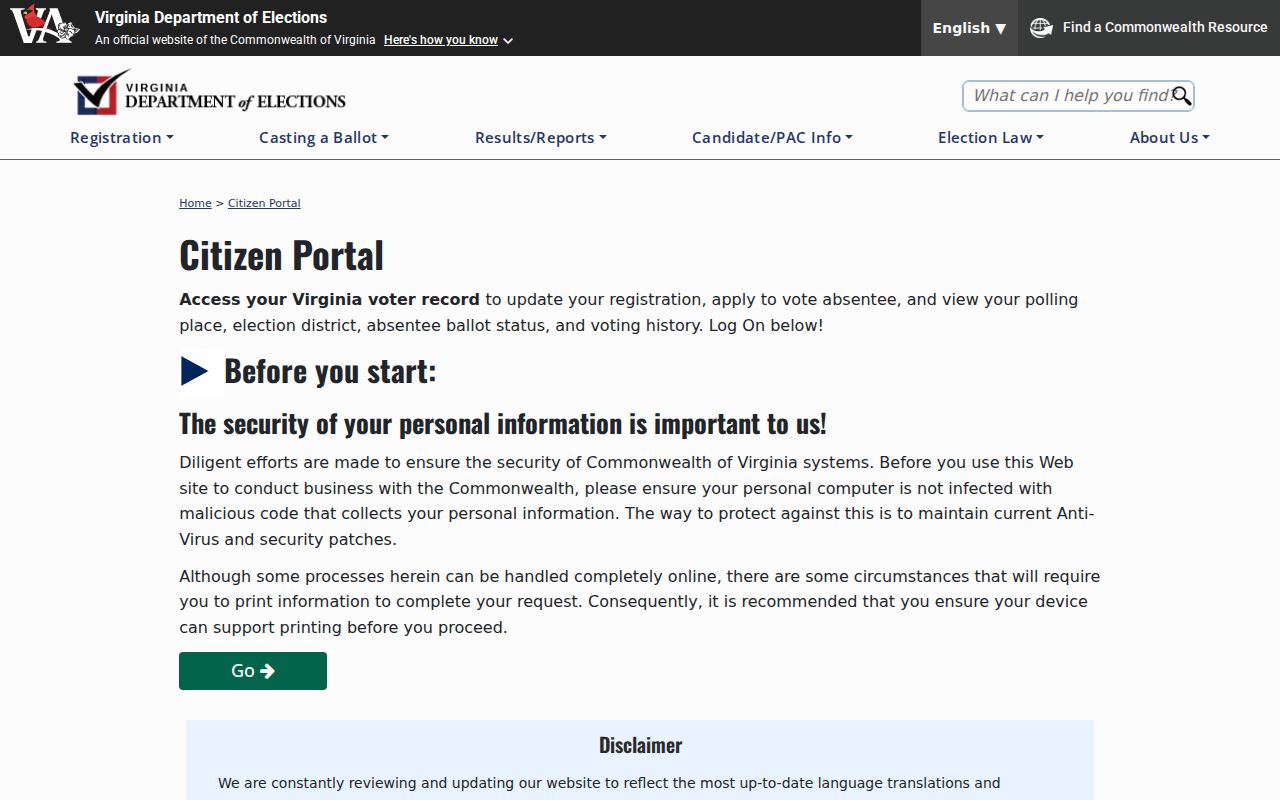
Use the portal to confirm an individual record or district information, and use the separate list-request process only within the rules that govern that product.
Fairfax Court Record Searches
Fairfax Circuit Court eCaseSearch is a useful resident lookup cross-check for civil and criminal index entries from October 18, 2004. The form requires a Civil or Criminal case-type choice, then asks for Party Name or Case Number. A party search needs at least the first two letters of the last name or company name; a first name is optional. A case number can be entered in the displayed court format. Results are limited to 100, and sealed matters are excluded. A party entry can help place a name at a time and jurisdiction, but it does not prove where that person lives now.
| eCaseSearch result field | Why it matters |
|---|---|
| Case number and case type | Identifies the court matter and provides the detail link |
| Date filed and current status | Places the entry on a timeline |
| Party names and attorneys | Helps test spelling variants and role in the case |
| Register of actions | Lists docket events, not the documents themselves |
The Fairfax Circuit Court eCaseSearch screen requires a case type and a party-name or case-number path.
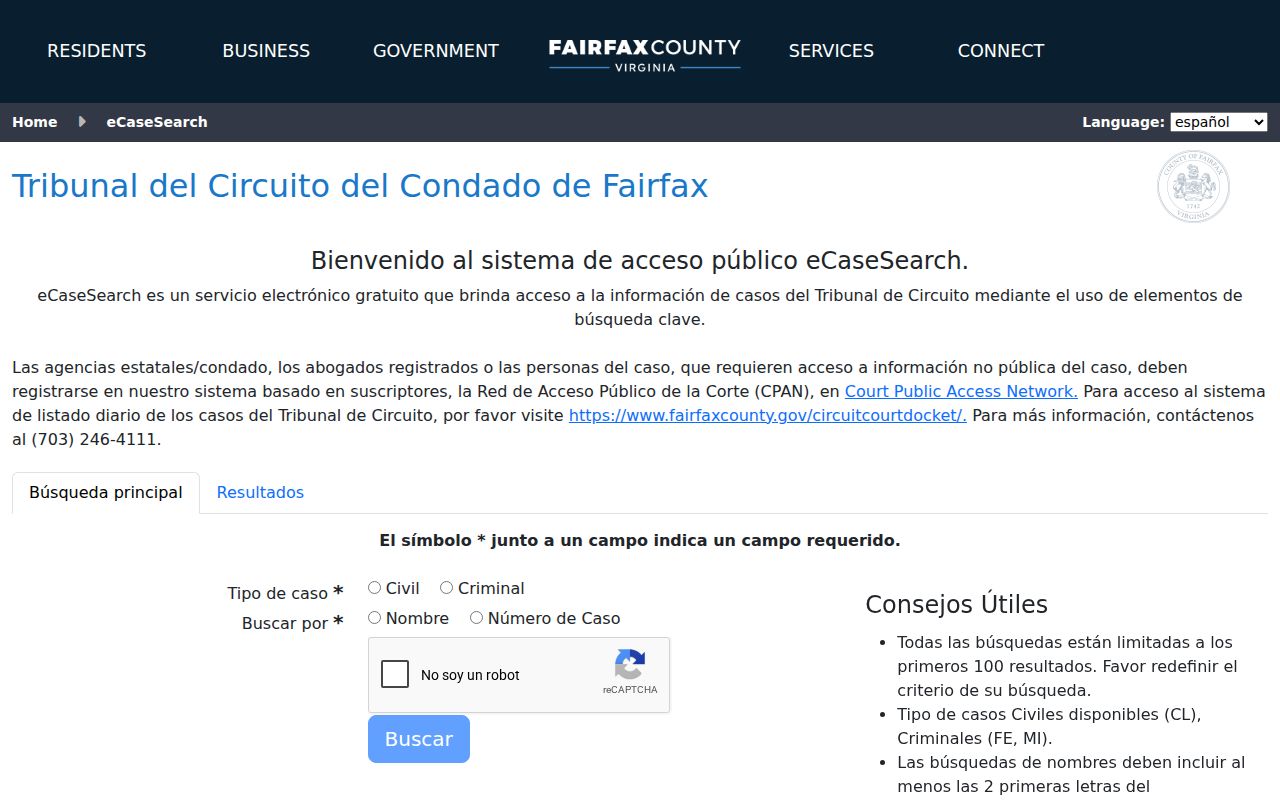
For a file or certified document, submit the Circuit Court file-review request and wait for staff notification, then use the clerk's copy procedure. Fairfax General District Court is a separate statewide case search, and City of Fairfax matters require the City selection. Juvenile, adoption, sealed, and expunged files are not ordinary public name-search results.
Fairfax Vital Record Checks
Vital indexes can help distinguish two people with the same name, but an index and a certificate do different jobs. Virginia Department of Health records show that birth and death records become public after 100 years, while marriage and divorce records become public after 25 years under Virginia Code §32.1-271. Current certified copies are mainly limited to the registrant, immediate family, guardian, or an authorized requester. Fairfax Circuit Court issues local marriage licenses and copies, while VDH maintains statewide certificate routes. An index should confirm an event, approximate date, and jurisdiction before a request is made.
VDH accepts online and paper applications. The inspected application process calls for a completed form, signature, acceptable ID copy, and payment. Its published estimate was about five business days online and about eight by paper, with a $15 search fee and no refund when a record is not found. For historical Fairfax research, the Historic Records Center holds selected birth, death, and marriage series, and the Library of Virginia holds archival material. Those alternatives matter when a current certificate is restricted or when an older record is outside the modern register.
The Virginia vital-record application route explains the online and paper request choices.
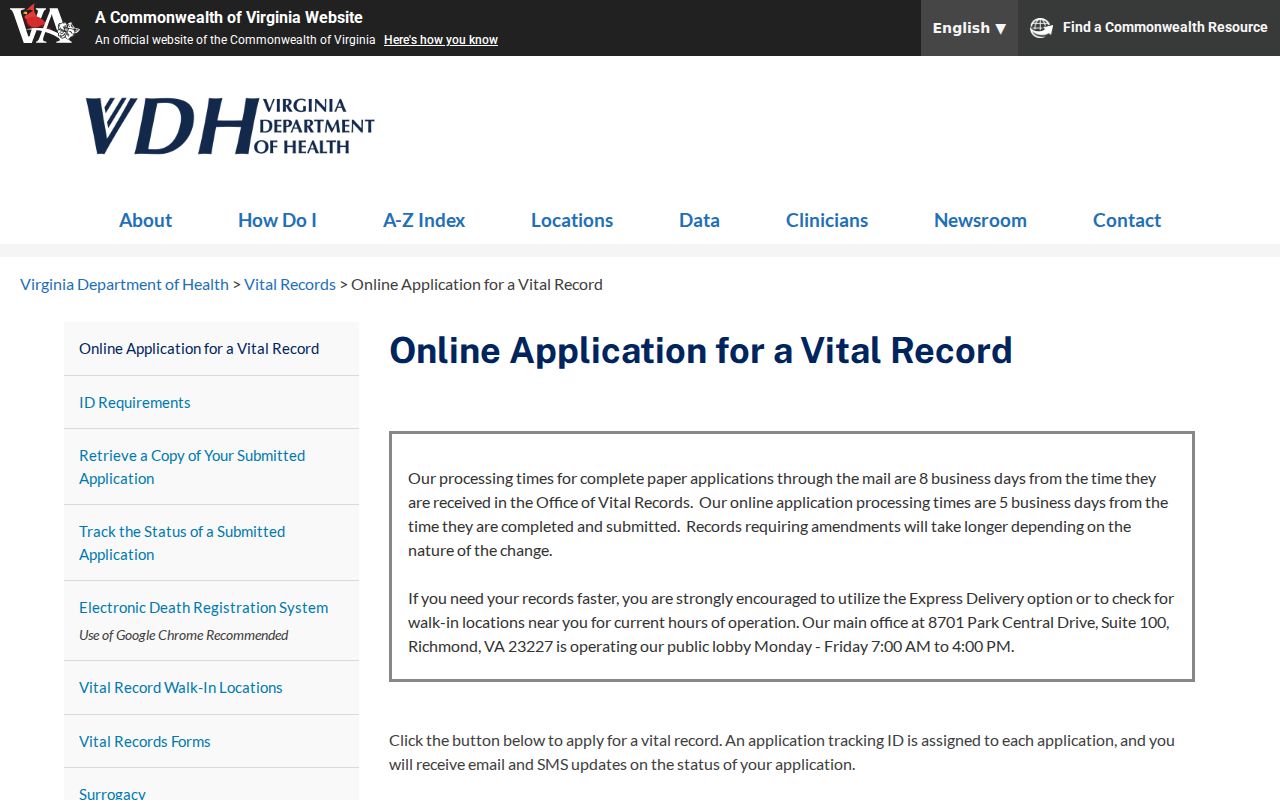
Check eligibility first, then use the VDH application or the Fairfax Circuit Court marriage-copy process for the precise record needed.
Note: A vital index can establish an event lead, but only the custodian can provide an eligible certified copy or explain a restricted record.
Fairfax Resident Yearbook Trails
For a former classmate or an older family connection, the Fairfax County Public Library Virginia Room offers a local route that does not claim to identify a current address. FCPL reports more than 300 digitized Fairfax County Public Schools yearbooks from 36 schools, nearly 500 physical yearbooks, and a photo archive with more than 13,400 images. The Virginia Room also holds directories, newspapers, maps, microforms, photographs, manuscripts, and a CPAN station. Identify a school and approximate year, capture the actual page image, then test a surname against an obituary, directory, probate file, or current official record.
The Fairfax Herald Index, 1886-1936, separates births, marriages, obituaries, and place names. The Fairfax County Independent run from April 11, 1929 through December 22, 1932 offers another local lead. These are index and collection routes, not comprehensive proof. The Virginia Room can be contacted by phone, email, or an in-person library visit when a catalog result needs staff interpretation. This historical layer is useful when a modern Fairfax resident lookup has no result or when the question is about a past connection.
Verify a Fairfax Resident
Use two independent attributes before treating a common name as a match. A middle initial, approximate year of birth, parcel PIN, spouse name, school year, business name, case date, or recorded date can all help. Keep name variants and initials. A tax owner and a voter with the same name can be different people. A docket address may be old, and an obituary can identify relatives without reporting a legal residence. The practical test is whether the records make one coherent timeline rather than merely repeating the same name.
- Anchor the name to one dated fact, such as a Fairfax parcel, court filing, school year, or vital-index event.
- Check a second official or archival source with a different purpose, such as an assessment record after a court result.
- Compare jurisdiction, date, address type, spelling, and related names. Mark any conflict rather than forcing a match.
- Ask the proper custodian for file review or an eligible certified copy when the original record, not the index, is needed.
- Docket
- A court's running list of filings and events in one case.
- Index versus image
- An index points to a record and key fields; an image is the scanned record itself and may have different access rules.
- Certified copy
- A copy issued or authenticated by the custodian for a defined official purpose, often with eligibility or fee rules.
Fairfax Resident Business Clues
A business or license record can distinguish people with the same name, but it is not proof of a Fairfax residence. The Virginia State Corporation Commission Entity Search works by entity name or SCC ID and can show filing images, entity type, formation date, registered agent, principal office, officers, or managers when the filing requires them. New assumed-name filings moved to the SCC on January 1, 2020. For an older local trail, the pre-2020 Fairfax trade-name index remains available through CPAN and public terminals in Suite 116 Land Records.
Virginia DPOR and DHP license lookups are separate official verification sources. They can show license information, status, dates, and public details where supplied. An address in a professional or entity filing may be a business or mailing location. Treat it as an affiliation clue, add the filing date, and cross-check it with a parcel, court, or historical source before using it in a resident lookup.
Fairfax Records Request Fallbacks
When an official trail ends, ask for the record type that already exists. The Clerk can direct a requester to a file location, review procedure, or copy process. Land Records has telephone, courthouse-terminal, Historic Records Center, and mail-copy channels. VDH provides online, mail, and in-person vital-record routes. The Virginia Room, Historic Records Center, and Library of Virginia can help identify historical collections when an online index is thin. Each option is narrower and more useful than asking an office to create a list of residents.
The Virginia Freedom of Information Act, Virginia Code §2.2-3700 et seq., is a route for existing nonexempt county records. Fairfax County directs requesters to start with the custodian most likely to hold the record, then use the county FOIA contacts if needed. A request does not override court secrecy, vital-record eligibility, sealed adoption files, or protected voter information. State law generally requires a response within five working days, with extensions, costs, or deposits handled under the statute when applicable.
Fairfax Resident Lookup Limits
Fairfax public records have real boundaries. Guests, relatives, and other occupants may not appear in a deed or assessment record. The Virginia Address Confidentiality Program provides qualifying participants a substitute mailing address, and protected voters may have special address treatment under Virginia Code §§24.2-418 and 24.2-444. Current VDH certificates have eligibility limits. Juvenile, adoption, sealed, and expunged matters may be absent from ordinary court results. Do not fill in a missing address from a compiled profile or assume an omission is an error.
If a government record is wrong, contact the custodian that holds it. Virginia's consumer privacy law does not erase a deed, court docket, or voter record that another law makes public. Avoid copying Social Security numbers, full birth dates, signatures, account numbers, or driver's-license data from a document. An official record can answer a narrow question, but it should not be stretched into a complete biography.
Lawful use. Use Fairfax records for personal, lawful research and do not use a name, address, or file detail to stalk, harass, threaten, or intimidate anyone. Virginia law treats repeated conduct that causes the statutory fear or emotional distress as stalking.